

Africa is no longer simply a collection of emerging blueberry origins. It is becoming a network of increasingly sophisticated production systems - and they are not all following the same path.
From hectares to farm performance
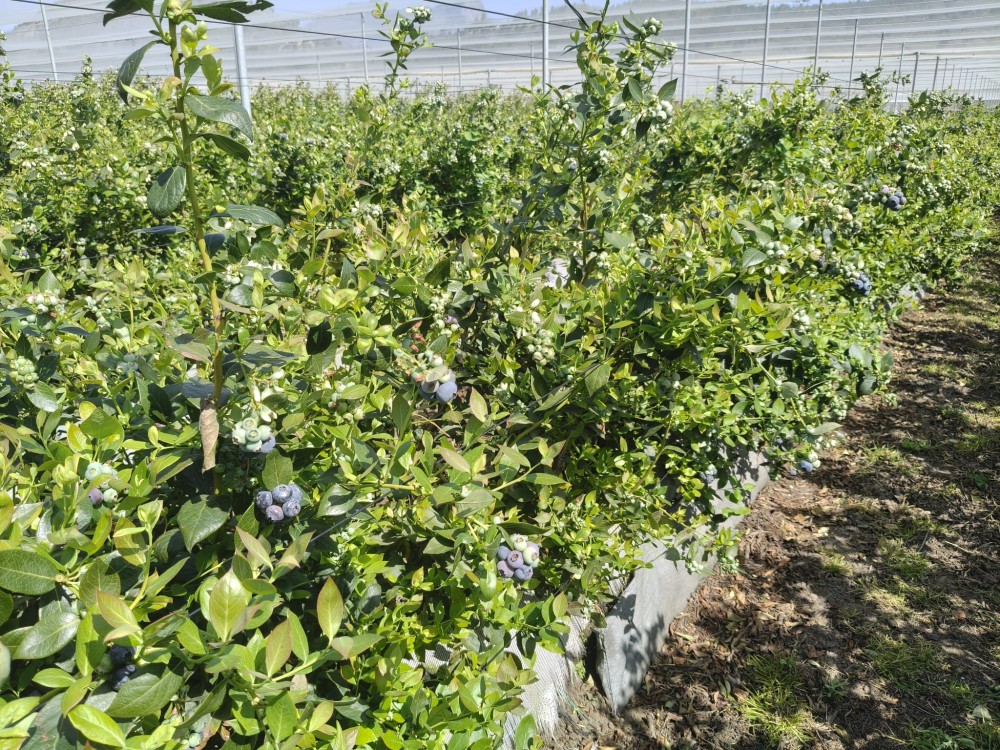
Recent field observations in South Africa show an industry that has changed significantly as it has matured. During the expansion phase, attention naturally centred on new projects, genetics, production areas and the speed at which planted area could grow.
Field observations increasingly point to planted area alone being an incomplete indicator. Farm-level performance - particularly marketable yield, packout, labour efficiency and postharvest consistency - is becoming more important.
Industry attention is increasingly centred on yield together with packout, berry size, picking efficiency, genetics, cooling, shelf life, logistics and market destination. The emphasis is moving from expansion to execution.
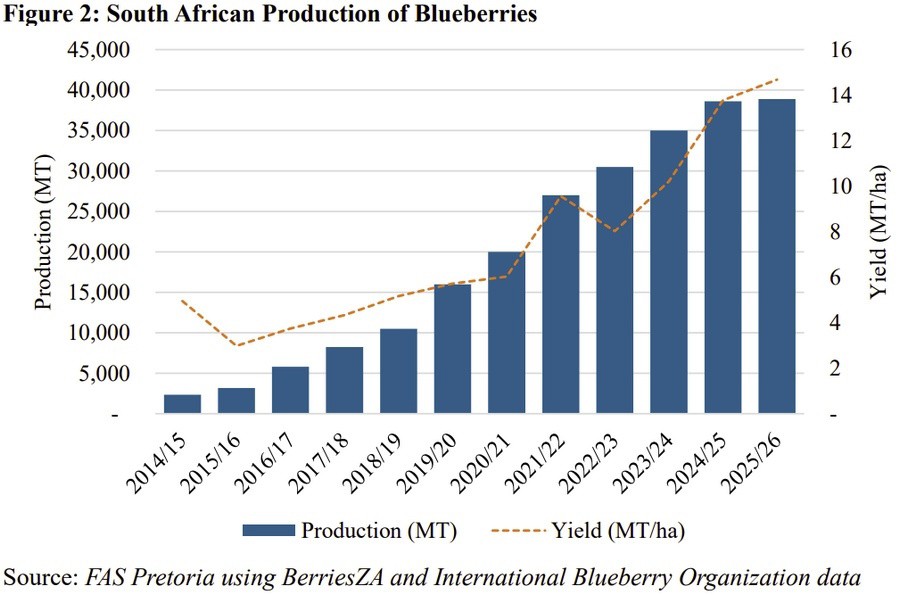
South African blueberry production has grown from less than 3,000 tonnes in 2014/15 to an estimated 38,900 tonnes in 2025/26
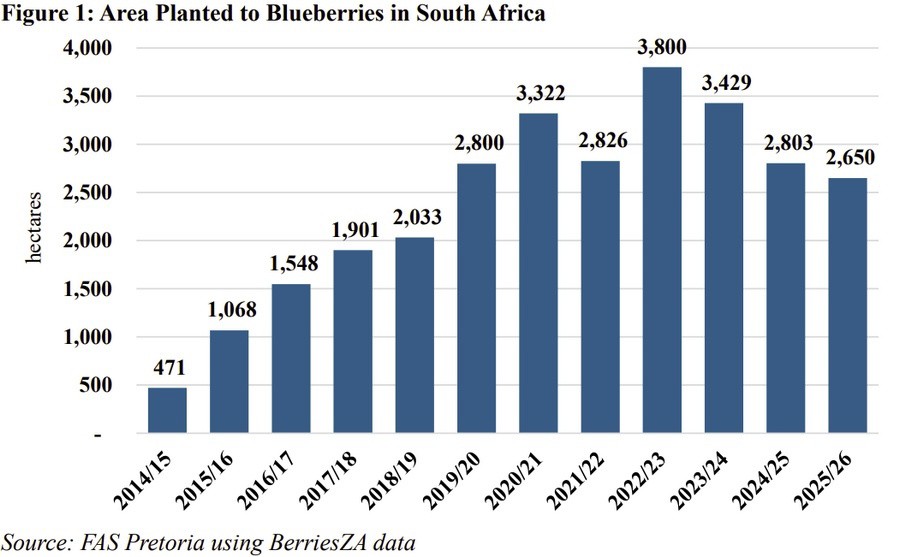
At the same time, planted area is reported to have declined from a peak of roughly 3,800 ha in 2022/23 to about 2,650 ha in 2025/26 (FreshPlaza, 2026a). Different sources use somewhat different crop-year and planted-area definitions, but the direction is clear: recent production growth is no longer simply a story of adding hectares.
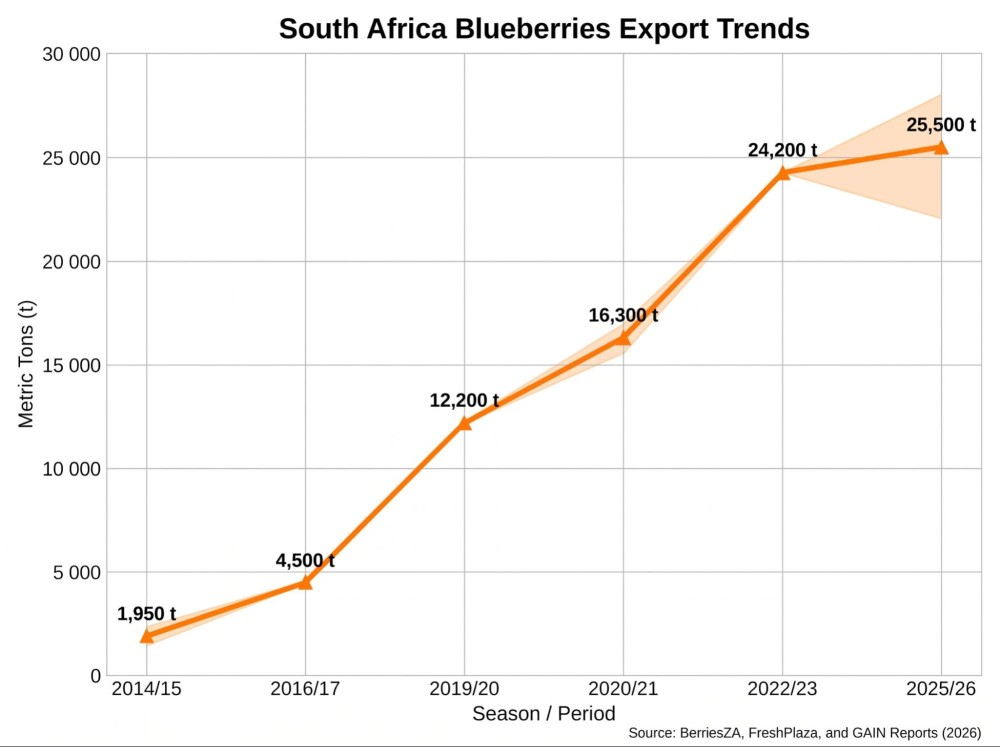
The first growth curve was financed with hectares. The second growth curve is being financed with knowledge.
At the other end of Africa, a different model
Several thousand kilometres to the north, Morocco is at another stage of the same industry. Field experience from Agadir through the northern production areas shows how rapid development has created one of Africa's largest and most dynamic blueberry production systems.
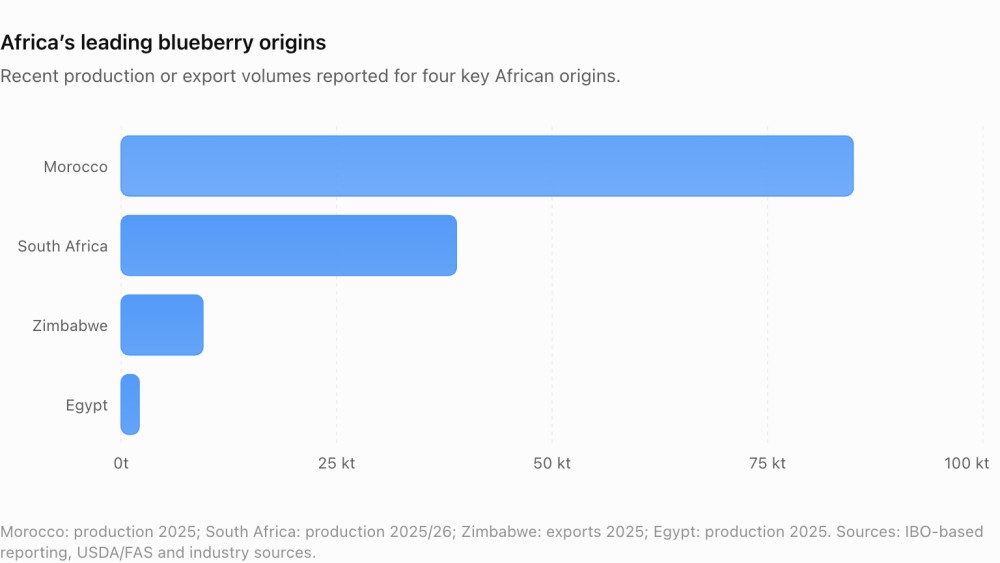
Recent IBO-based reporting places Morocco at around 6,800 planted hectares in 2025, with about 5,800 ha bearing and production close to 84,940 tonnes (FreshPlaza, 2026b). Unlike South Africa, Morocco is still converting substantial new area into new production.
At opposite ends of the continent, two different growth dynamics are visible. Morocco remains strongly driven by expanding and maturing hectares. South Africa is increasingly being forced to obtain more commercial performance from an established and, by some measures, smaller planted base.
This does not make one model better than the other. It makes the comparison useful.
Africa is not one blueberry origin
Talking about 'African blueberries' as if the continent were one production region hides the most interesting part of the story. Climate, latitude, altitude, production systems, labour structures, market windows, infrastructure and logistics vary enormously.
Morocco has built scale around a strong winter-spring window, modern protected and substrate production, proprietary genetics and relatively short access to major export markets. South Africa has developed as a long-distance export origin where postharvest performance, cold-chain discipline and fruit durability are fundamental parts of the production system.
That distinction matters because a blueberry is not commercially finished at harvest.
The fruit is judged at consumption.
This principle applies particularly well to African blueberry production: the commercial crop is not simply the fruit hanging on the bush. It is the fruit that reaches the customer within specification.
Climate is testing both African models
North and Southern Africa face different weather patterns, but both are being forced to design systems for greater variability.
Morocco's 2026 season illustrated the exposure of a rapidly expanding protected-crop industry. Field observations recorded repeated storms, low radiation, wind and excess water affecting crop continuity, fruit sizing and infrastructure in some production areas. Published industry reporting also described substantial local impacts, particularly in northern farms (International Blueberry Organization, 2026a).
South Africa has faced a different combination of risks, including frost in northern areas in previous seasons and episodes of exceptional rainfall and flooding in the Western Cape. Field and industry observations show that impacts can differ substantially between regions, cultivars and production systems. National averages therefore become less useful when operational decisions must respond to increasingly localised extremes (International Blueberry Organization, 2026b).
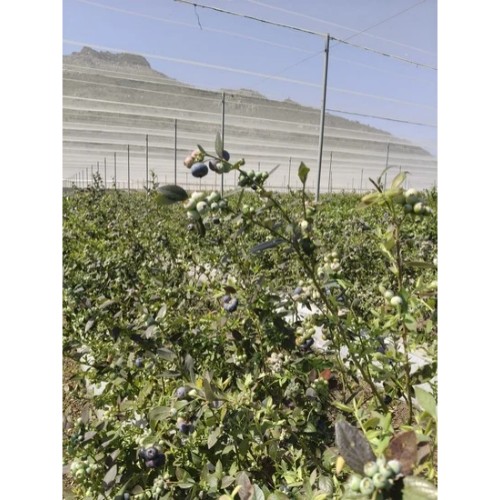
For African blueberry investors and growers, robustness therefore needs to sit beside efficiency. A system designed only for the average season may be highly efficient on paper and surprisingly fragile in the season that actually arrives.
Genetics is becoming operational technology
The next phase of African blueberry development will not be explained by hectares alone. Genetics will influence not only yield, flavour and firmness, but labour, harvest efficiency, packout and logistics.
A simple calculation illustrates the labour dimension. One kilogram of 2 g berries contains roughly 500 individual fruit. At 3 g, the same kilogram contains about 333. Berry count is not the same as picking speed, because detachment force, cluster architecture, ripening uniformity and plant structure also matter. But fewer fruit handled per kilogram can materially change labour productivity.
This is particularly relevant in Africa. Competitive labour costs do not remove the need for labour efficiency. The metric that matters increasingly is not the daily wage alone, but the labour cost per marketable kilogram.
Genetics also has to fit the journey. A variety for a nearby market and a variety expected to tolerate extended storage and long-distance transport do not necessarily need the same combination of firmness, scar, bloom, size, flavour and dehydration resistance.
South Africa: from expansion to optimization
South Africa is therefore interesting not because it is Africa's largest blueberry producer - it is not - but because it shows what happens after a rapid planting cycle meets global competition, logistics costs and tighter margins.
Recent industry commentary attributes improvements to maturing orchards, newer genetics, better production methods and stronger management rather than simply new area (Fruitnet, 2026). Field observations are consistent with this transition, with greater attention being placed on productivity, fruit specification, labour efficiency and postharvest execution.
The questions become more operational: How much fruit is exportable? How fast can it be picked? How quickly is field heat removed? What is the pulp temperature entering storage? Can the fruit travel by sea instead of air? What percentage arrives in specification? What does a claim do to the apparent field margin?
Long-distance production forces these questions early. South Africa's geography can be a disadvantage, but it has also forced the industry to build knowledge around the journey.

Morocco: managing the consequences of success
Morocco faces almost the opposite strategic challenge. Its extraordinary growth has created scale, professionalisation and an increasingly important position in global blueberry supply. But rapid success creates its own risks.
Field experience in Morocco highlights a less visible consequence of rapid expansion: when growers target similar windows, use related genetics and face the same weather sequence, biological calendars can become increasingly synchronised. Thousands of hectares do not make commercial decisions together, but climate and phenology can make them harvest together.
This can be described as a '5,000-hectare syndrome': the point at which agronomic success begins to create commercial concentration. More hectares, better genetics and higher productivity are positive individually, but if they place too much fruit into the same weeks, the system requires stronger market diversification, harvest planning, cooling capacity, labour organisation and commercial coordination.
Morocco's next challenge is therefore not proving that it can produce blueberries. It is managing scale without allowing scale to erode value.
Zimbabwe is no longer an experiment
Southern Africa is also becoming more than South Africa.
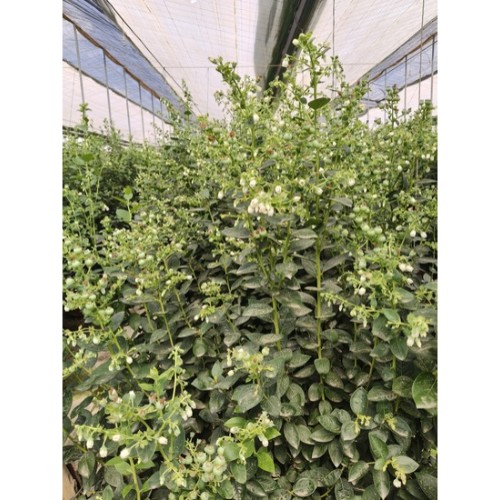
Zimbabwe has moved rapidly from a small origin into meaningful commercial production. Recent industry reporting places the sector around 650 ha and approximately 9,500 tonnes exported in 2025, with further expansion expected in 2026 (International Blueberry Organization, 2026c).
More importantly, Zimbabwe secured blueberry market access to China and began commercial shipments in 2026 (International Blueberry Organization, 2026d). Market access changes the strategic value of an origin. It creates alternatives, reduces dependence on a single destination structure and can support investment in varieties and production windows designed for different customers.
Zimbabwe also raises an important question for the region: can a newer industry use the experience accumulated in South Africa to avoid some of the costs of learning through rapid expansion?
Egypt: the northern challenger
Egypt plays a similar emerging role in North Africa. Its blueberry industry remains much smaller than Morocco's, but it sits inside an enormous horticultural export economy with established infrastructure, labour, production knowledge and access to several geographic markets.
Recent trade reporting indicates a sharp increase in blueberry exports during the first half of 2026 (FreshPlaza, 2026c). The exact relationship between reported production and calendar-year export data requires caution because different datasets use different periods and definitions. The direction, however, is relevant: commercial interest and export activity are increasing.
Egypt has an opportunity that Morocco did not have at the same stage: it can observe what happened when another North African blueberry industry expanded rapidly and design its genetics, market windows, water strategy, postharvest systems and commercial scale accordingly.
And what about Zambia and Namibia?
Smaller origins matter because they test the assumption that a successful blueberry model can simply be copied into the neighbouring country.
It cannot.
The IBO's African data have recorded commercial blueberry production in Zambia and Namibia, but at a much smaller scale than South Africa or Zimbabwe (International Blueberry Organization, 2024). These projects are useful precisely because they expose the importance of local conditions: climate, altitude, water, management depth, freight, technical support, genetics and distance from decision-makers.
Practical observations across multi-country berry developments show that rapid expansion can outrun the management system supporting it. A project may have suitable climate and still struggle commercially if the operating model, technical team, logistics or scale are inadequate.
Potential must be converted into an operating system.
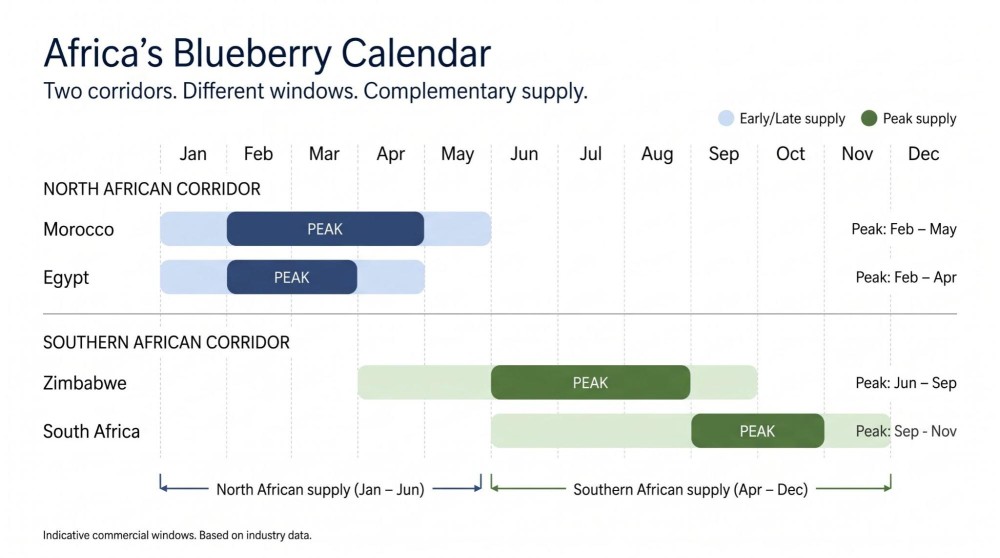
Perhaps Africa is developing two blueberry corridors
|
North Africa |
Southern Africa |
|
|
Established engine |
Morocco |
South Africa |
|
Emerging scale origin |
Egypt |
Zimbabwe |
|
Smaller tests |
Other North African opportunities |
Zambia, Namibia and other niches |
|
Core strengths |
Scale, winter-spring window, modern genetics, export proximity |
Operational know-how, counter-seasonality, genetics, export systems |
|
Core challenges |
Water, climate volatility, peak concentration, managing rapid growth |
Distance, logistics cost, infrastructure, market access |
|
Next performance question |
How to protect value as volume expands |
How to increase marketable output and value without relying on more hectares |
These are not closed corridors, and market destinations extend well beyond the regions implied by geography. The point is structural: North and Southern Africa are accumulating different combinations of climate, scale, knowledge, logistics and market access. Over time, the competitive unit may become less the individual country and more the network connecting production zones, genetics, exporters, cooling infrastructure and customers.
Postharvest is agronomy too
Field experience with long-distance African supply consistently shows that postharvest cannot be treated as something that starts after agronomy ends.
Field-to-cooler time, forced-air precooling, pulp temperature, humidity, sorting, packaging and an uninterrupted cold chain determine how much of the biological crop survives as commercial crop.
This is why the phrase 'the fruit is judged at consumption' matters. A 20 t/ha orchard whose fruit cannot tolerate the required supply chain may be a worse investment than a lower-yielding orchard with higher packout, better picking efficiency and more reliable arrival quality.
For South Africa and Zimbabwe this is obvious because of distance. For Morocco and Egypt it remains equally relevant because rapid growth increases the amount of fruit that has to be harvested, cooled, packed and moved during increasingly concentrated peaks.
The next African growth curve
Africa's blueberry story is no longer about proving that blueberries can be grown on the continent. That question has been answered.
Morocco is approaching a scale that would have been difficult to imagine only a decade ago. South Africa is showing that an industry can move from planting-led growth toward productivity and operational improvement. Zimbabwe is becoming a commercial origin with new market access. Egypt is beginning to scale. Smaller Southern African projects are testing where the model can and cannot travel.
The next questions are harder.
How many tonnes are marketable? How many kilograms can a worker pick per hour? How much cooling capacity exists during the peak week? How much fruit can travel through lower-cost logistics? How stable is quality after the required journey? How exposed is the farm to one market, one climate window, one port or one variety?
Those are not hectare questions. They are system questions.
Africa's next blueberry chapter may be defined less by who plants the most hectares and more by who converts genetics, climate, people, infrastructure and market access into the most consistent marketable kilogram.
The relevant measure is therefore not simply biological production, but the quantity and value of fruit that can be converted consistently into marketable output.
The key question is no longer how much can be grown, but how much of that production can be converted into commercially valuable fruit.
Field observations in this article reflect the authors' practical experience across commercial berry production systems and are used to complement the published industry sources cited below.
References
FreshPlaza. (2026a). South African blueberry production reaches 38,900 tons in 2026. FreshPlaza.
FreshPlaza. (2026b). Blueberry crop in Morocco could increase nearly 70% by 2029. FreshPlaza.
FreshPlaza. (2026c). Egyptian blueberry exports rise nearly 267% in first half of 2026. FreshPlaza.
Fruitnet. (2026). South African blueberry season shows strong growth and quality. Fruitnet.
International Blueberry Organization. (2024). Global state of the blueberry industry report 2024. International Blueberry Organization.
International Blueberry Organization. (2026a). Storms hit Moroccan blueberry industry, with volumes and sizing both affected. International Blueberry Organization.
International Blueberry Organization. (2026b). South African blueberry season faces extreme weather realities: Resilience amid localized disruption. International Blueberry Organization.
International Blueberry Organization. (2026c). Zimbabwe's blueberry boom keeps building momentum. International Blueberry Organization.
International Blueberry Organization. (2026d). Zimbabwe begins blueberry shipments to China. International Blueberry Organization.
Agribook Digital (2026) Berries and Exotic Fruit – Industry Overview & Production Trends