

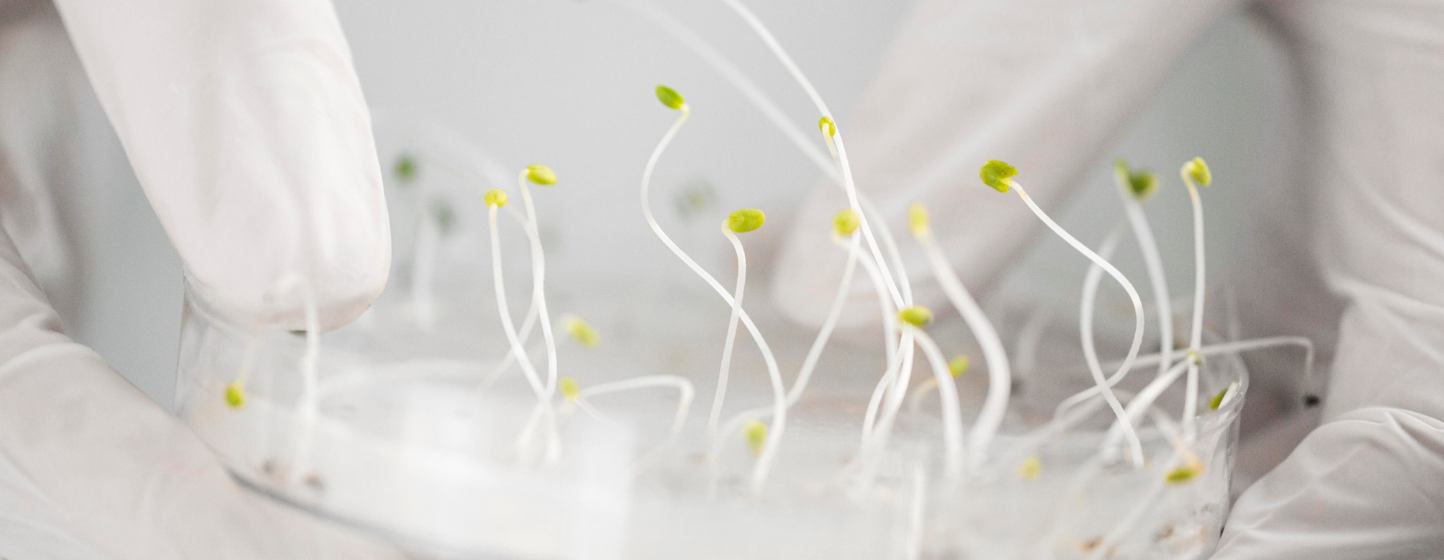
It enables cells to grow back into a complete plant without adding hormones, relying instead on the activation of just two genes.
Carried out in close collaboration with KeyGene, the work could deliver major time savings for breeders—particularly in species where conventional protocols remain difficult to reproduce. The study was published in the scientific journal The Plant Cell.
Understanding regeneration
Some plants can form a root, a leaf, or even an entire plant from a single cell. “We call this regeneration,” explains Jana Wittmer, a cell biology researcher at WUR. In principle, a specialised cell (from a root or a leaf, for example) can be reverted to an undifferentiated state, comparable to that of a stem cell, and then differentiate again to form different organs—ultimately rebuilding a whole plant.
A core tool for maintaining varieties
Regeneration is widely used in agriculture, particularly in plant improvement. It makes it possible to produce new plants while passing on the original plant’s genome unchanged. “This allows the genetic composition of a plant or a variety to be preserved across several generations,” Jana Wittmer notes.
Until now, the process has relied on adding plant hormones to the culture medium. Young tissues are often preferred, as older, more differentiated tissues respond less effectively to these treatments. By adjusting the “hormone regime,” it is possible to steer stem-cell development toward roots or shoots.
The limits of hormone-based protocols
However, these approaches come with constraints. “It is a very labour-intensive and time-consuming process,” the researcher points out. The optimal hormone combination must first be determined through trial and error, and each species—or even each variety—may require a different protocol. For certain crops, such as pepper or cucumber, there is still no reliable hormone scheme that enables reproducible regeneration. Even when it works, hormone-based regeneration remains slow, demanding, and costly.
An alternative inspired by induced pluripotent stem cells
The researchers therefore explored a hormone-free route. Their inspiration came from a Nobel Prize–winning animal method based on induced pluripotent stem cells. In plants, regeneration involves a transient stage in which root stem cells form. The team—specialists in these cells for many years—tested different gene combinations to “reprogramme” cells into a stem-cell state capable of subsequently producing any organ.
A key discovery: two genes are enough
After multiple experiments, the researchers managed to regenerate plants without adding hormones. The most striking finding: only two genes are required to initiate the process. “After that, there is no further need for intervention: plant cells organise themselves,” Jana Wittmer explains. From a clump of cells, a complete plant reforms.
The method has been demonstrated in the model plant Arabidopsis, but also in crops such as tomato, lettuce and pepper. “In principle, the technique could therefore be applied to a wide range of species, including those that do not respond to hormones or for which we have not yet found an appropriate treatment,” she adds.
Beyond saving time and labour, the approach could also make it easier to introduce or switch off genes—steps that likewise depend on regeneration. Ultimately, this could help develop plants that are more resistant to diseases and pests, with potential positive impacts on yields and the environment.
Toward a non-GMO version
The researchers stress, however, that the technique is not yet ready for real-world use. In the lab, they modified the plants’ genetic material, and commercialising genetically modified plants in Europe remains complex and costly. The next goal is to activate the regeneration genes without genetic modification.
One potential route is to introduce the proteins encoded by these genes directly into cells. If feasible, this could accelerate practical deployment, but further work is needed.
Opening new avenues for research
For the scientific community, this induction system also creates new opportunities: it makes it possible to study regeneration mechanisms more precisely—and more easily. It also raises new questions, such as why regeneration works very well in some cell types and species but not in others.
Another avenue is to maintain the “stem cell” state over longer periods. Today, gene activation triggers the formation of stem cells that immediately regenerate a plant. If that state could be stabilised, it might become possible to direct these cells toward specific cell types—for example, those capable of producing pharmaceutical compounds or other high-value molecules. A promising direction, still to be explored.