
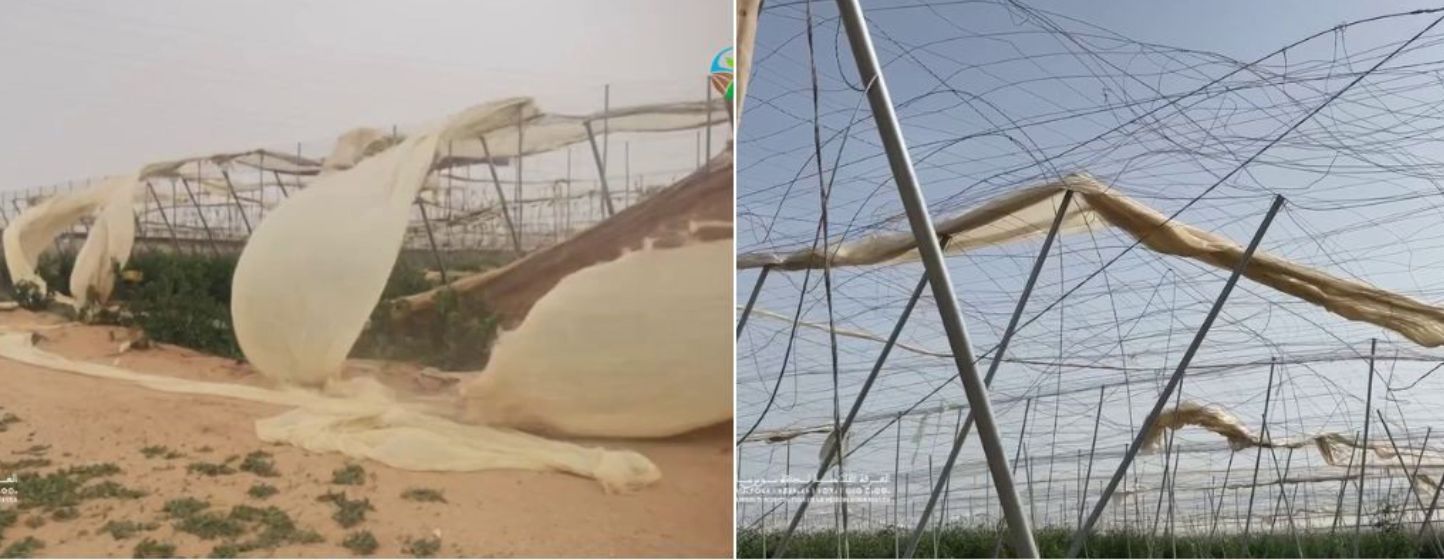
According to growers’ representatives, the damage to crops and greenhouse infrastructure is described as “catastrophic and shocking.”
Unprecedented damage to greenhouses
The storm lasted just over an hour on February 26 around 6:30 PM, with wind speeds reaching 100 km/h. Several agricultural areas were affected, including Chtouka Ait Baha, Belfaa, Inchadn, Biougra, Houara, Ait Amira and Sidi Bibi.
According to Ahmed Afkir, a grower in Chtouka Ait Baha, the scale of the damage is exceptional, with thousands of hectares of greenhouses damaged or destroyed, a level of losses rarely seen in the region.
In response, growers are trying to harvest as quickly as possible what can still be saved before additional rainfall arrives. For some producers, the season may end prematurely.
Impact across several agricultural sectors
Losses affect several crops, including tomatoes, peppers, beans and berries. The storm has also worsened existing phytosanitary issues already limiting tomato production.
According to growers, these disruptions could lead to supply shortages on both local and export markets in the coming weeks.
Damage assessment underway
Following field visits and an emergency meeting with growers’ organizations, the Souss-Massa Chamber of Agriculture has established a commission to assess the damage and formulate the sector’s support requests.
The damage extends to several provinces, including Taroudant, Tata and Tiznit, in addition to greenhouse-intensive areas such as Chtouka Ait Baha.
Plastic shortages complicate reconstruction
Beyond the crop losses, growers are also warning about a shortage of greenhouse plastic, which is slowing down reconstruction efforts. Supply delays already exceed one week and could increase further if raw material shortages occur.
The situation is further complicated by labor shortages and rising costs for inputs, materials and logistics.
Risks for the next production season
Under these conditions, the premature end of the current season could be followed by a delayed start to the next season, as growers struggle to rebuild greenhouse infrastructure.
Sector representatives are calling on authorities to declare the region an agricultural disaster area and provide support for greenhouse reconstruction.
According to some producers, international buyers—already informed of the situation—have begun looking for alternative sourcing options for their supply programs.