
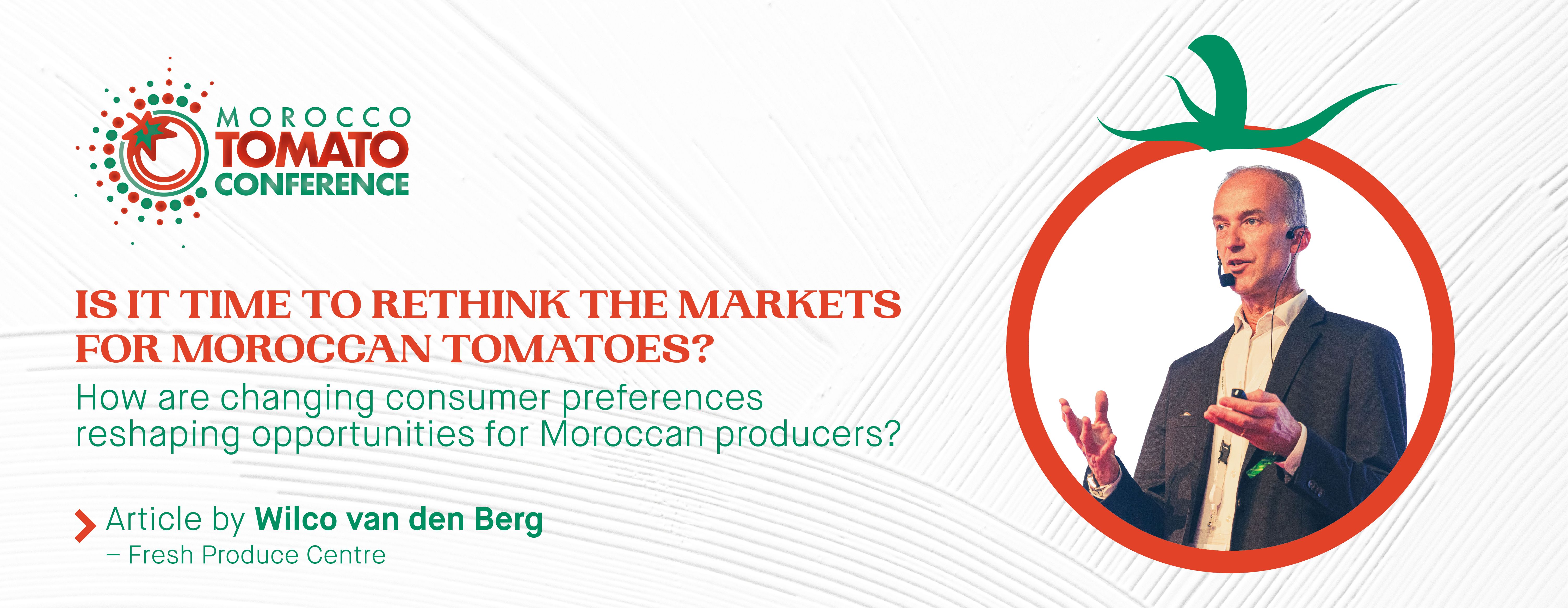
Tomatoes are the most consumed vegetable worldwide, by far. We are no longer eating the same varieties as we were twenty years ago. The landscape of tomato consumption is constantly changing. It was a pleasure to speak at the Morocco Tomato Conference in Agadir on May 21st about the European market presenting: "Tomatoes: Then, Now, Next: How to respond to the changing landscape of consumption in Europe?"
When rethinking markets, it is important to first rethink the current assortment. In various European supermarkets, traditional round tomatoes are either no longer available or there is limited availability. Cherry tomatoes are also losing their market share in Europe. At the same time, demand for premium tomatoes is increasing. The question is can Morocco produce these premium varieties, and do so consistently at a high quality? Diversification is necessary to serve a broader range of customers and reduce risk.
Higher level
Forty years ago, the Dutch tomato sector faced a bleak outlook. The image of Dutch tomatoes was poor, but by fully committing to supply segmentation and focusing strongly on taste improvement, the Dutch tomato industry has built a strong position. Vine tomatoes and snack tomatoes are popular among European consumers. New flavorful varieties, high-tech greenhouses, data-driven sustainable cultivation, and logistics have lifted the Dutch tomato sector to a higher level.
Consumer preferences
Start by identifying your target markets, understanding consumer preferences, and determining the role of Moroccan tomatoes. Who is the European tomato consumer? Preferences vary widely across Europe and market research is essential to making the right decisions. Learning to use consumer insights in a data-driven world is a valuable tool to becoming a leading tomato producer.
Rising EU consumption
The Netherlands is the world's second largest exporter of tomatoes, after Mexico, with Morocco ranking third. In 2025, the Dutch tomato production (938 million kilograms) and export (1.059 million kilogram; including re-export) reached record levels. After a small decline in EU consumption of tomatoes (2022, 2023) the consumption recovered in 2025. Compared to 2024, consumption increased by one percent to seven percent in countries such as Germany, the Netherlands, Italy, Sweden and United. At the same time, the share of tomatoes from outside the EU in the total EU consumption increase from six percent in 2016 to twelve percent in 2025.
No choice overload
In some European supermarkets, it is possible to find twenty to twenty-five different tomato varieties. Doesn't the consumer get confused or overwhelmed by the wide variety of tomatoes? Could this lead to choice overload? The answer is no. Fresh Produce Centre (the Netherlands) conducted a consumer research study on the optimal number of tomato varieties in the supermarket without causing choice overload for consumers. The study created one shelf with eight tomato varieties and a second shelf with eighteen varieties. Both shelf assortments were satisfactory for consumers. When customers were faced with more varieties, they bought more. However, they did not choose a larger number of varieties, instead, they purchased larger quantities of the same varieties. In both shelf setups (eight or eighteen), the consumer didn't become confused or overwhelmed. Irrelevant of the setups and the number of varieties offered, assisting consumers in choosing the right tomato for the right dish can be beneficial. Introducing new ideas and relevant information on how to best use the tomatoes can increase sales.
Good health and convenience
What will come next for Europe? Food trends are expected to simplify and return to basics. Prioritizing health, great taste, and convenience are important topics. Previously, fibre was a less important topic and generally seen as "boring." Currently, it’s seen as a "superfood" and has gained popularity on social media, particularly in the fitness and health and wellness industry, and has its own trending hashtag: "fibre-maxing." Europeans are constantly on the move, and snack tomatoes are gaining traction in Europe. A further shift from round tomatoes to vine tomatoes or snack tomatoes is predicted to continue. The most important attribute for consumers when purchasing produce is great taste. If the taste is off or sub-par, consumers will not return. In conclusion, consumer insights are essential for making the right decisions now and in the future! It is time to move from commodity thinking to premium thinking.
Wilco van den Berg
Fresh Produce Centre, the Netherlands